Monday, February 14, 2011

What are your (girl) FRIENDS up to?

So, since our FRIENDS have all been up to such interesting projects since their time at Central Perk, I thought a friendly check-in was due.  

THE ONE WITH TWO PARTS: PART ONE: THE GIRLS.


JENNIFER ANISTON:  Aniston has had a string of successful/semi-successful romantic comedies as of late.  Just coming out this weekend was JUST GO WITH IT, co-starring Adam Sandler.  While jury is out on how well this will really go over, the reviews have been mixed.  Rotten Tomatoes critic forum gives it a terrible 18%, leading me to conclude it can't be that good.  But previous rom-coms THE SWITCH (co-starring Jason Bateman) and THE BOUNTY HUNTER (co-starring Gerald Butler) have been more successful.  The question is, if she is 42, why is she doing romantic comedies?  Now ask anyone who knows me and they will tell you that adore Ms. Aniston, but why is she still doing these movies?  Her days as a dramatic actress in a film like THE GOOD GIRL were strong, but fleeting.  Where have these juicer roles gone for her?  She needs to do more roles like this.  And while I appreciated her stint opposite bff Courtney Cox in sitcom COUGAR TOWN, this is not her arena anymore.  Aniston needs to sink her teeth into some serious meat.  
(Though on a side note, I appreciate her outspoken friend Chelsea Handler, who denounced Angelina Jolie on her E late night show, Chelsea Lately, for Aniston, something Cox couldn't do).  
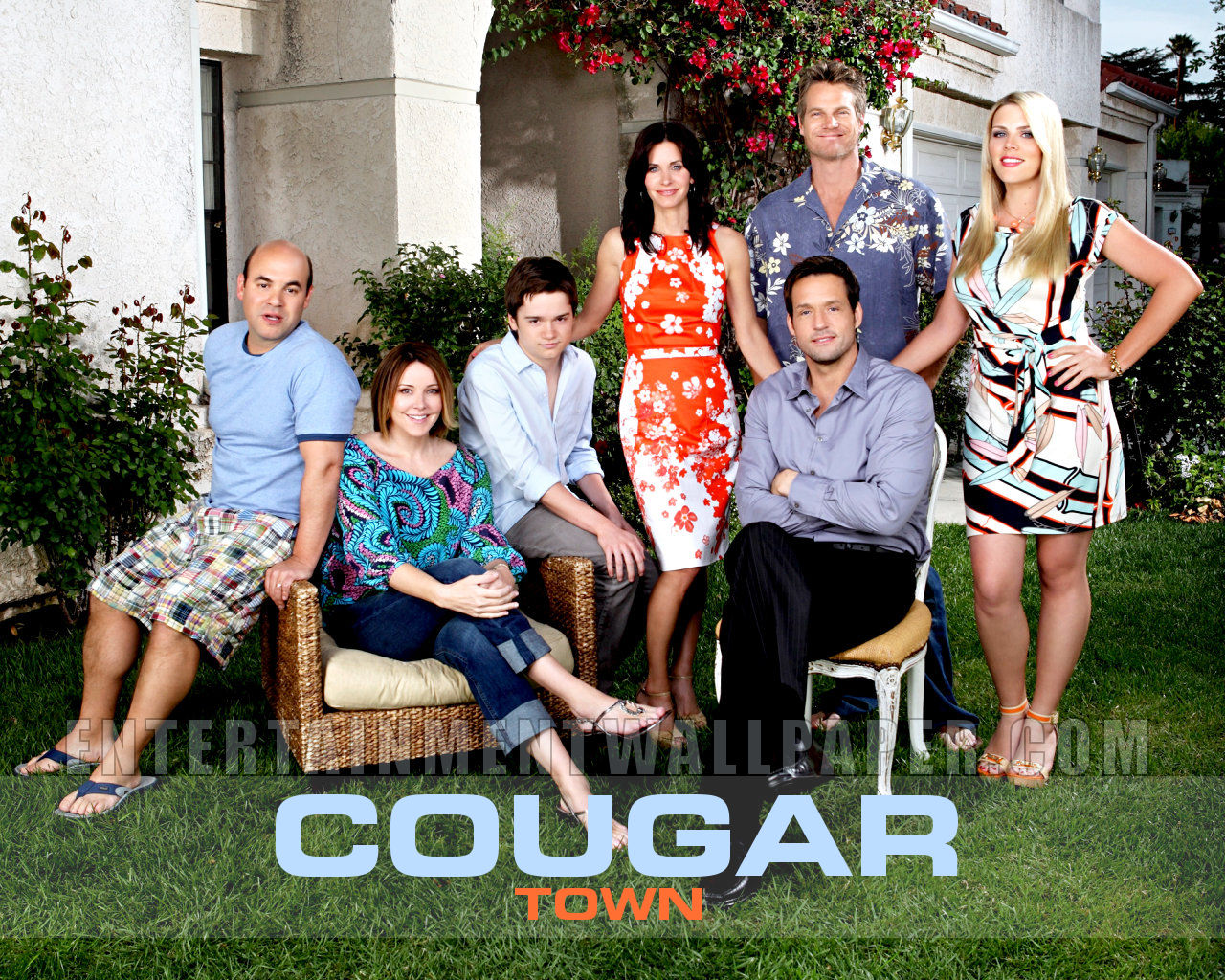
COURTNEY COX: Cox has been keeping very busy, just like gal-pal Aniston.  She has been starring in her suburban cul-de-sac of a show called COUGAR TOWN on ABC.  In it's second season, Cox is the only friend who has really done the sitcom game again.  With this show (though hideously titled) Cox plays an older woman, looking for love.  With its off-beat humor and notable one-liners, the show can soar.  However, it is certainly not as endearing as FRIENDS was as it often times lacks depth and heart.  But, between another sitcom, like TWO AND A HALF MEN, COUGAR TOWN this show will win out every time.  Why?  Because TWO AND A HALF MEN is sitcom-slime to the tenth degree and really dumbs down it's audience.  Even though COUGAR TOWN doesn't take itself seriously, just like it's Sheen-starring counterpart, it does have really interesting characters and a new take on the love triangle plot line.  Plus with guest stars like Emmy-gold Aniston, and series regular tv-icon Busy Philips, the show has some street-cred.  But, only a bit.  Will it last 10 season like FRIENDS?  Hell no.  Does it add to the fun of Comedy Wednesday on ABC, yes.  And to Cox's credit, she does not play Monica in this sitcom.  Something her other FRIENDS have been pigeonholed into.  

LISA KUDROW:  Kudrow has kept her recent activity fairly quiet, though guest spot on Cox's COUGAR TOWN did keep her busy for a week or so in 2010.  But beyond that, and that terrible movie HOTEL FOR DOGS, she has been keeping a low-profile.  The most recent film she was in (that was of worth) was EASY A, starring the newcomer (and now red carpet maven) Emma Stone.  Kudrow plays a guidance counselor at Stone's high school.  This off-beat character fits Kudrow, but isn't too much like her alter-ego Phoebe.  She has some great actors to play off of in this film including Stanley Tucci, Malcolm McDowell and Thomas Haden Church.   
Kudrow has some phenomenal lines in this film including my personal favorite: 
"He brought a knife to school. It's just a butter knife,
but you know what they say, it's a gateway knife."


But Kudrow has also been creating a one-woman improvised webisode WEB THERAPY where she plays a therapist.  You can visit the site here: http://www.lstudio.com/web-therapy/  Though I haven't heard too much about it, at least she is doing something and keeping her comedy alive.

NEXT UP?  What are your (boy) FRIENDS up to?  


Friday, February 11, 2011

SUNDANCE 2011: JESS + MOSS

JESS + MOSS is a really wonderful film about two kids (Jess is 18, Moss is 12) and their summer in Kentucky.  While the two seem an unlikely duo due to their age difference, they are actually the best of friends and know each other better than anyone.  Dealing with tragedy (Moss's parents passed away tragically) they find ways to relate.  But the story is not really why you should see this film.  It's really more of a concept film than an actual plot-driven film.  Because, nothing really happens.  Yep, there is no plot.  However, you do learn an awful lot about these characters throughout the course of the film.  In a way, it sort of reminds me Kristen Dunst's MARIE ANTOINETTE in that nothing happens, but then so much happened, too.  However, unlike MARIE ANTOINETTE, these characters have a real arc and history (no pun intended).

The film concentrates on the theme of memory.  A fascinating choice when you consider that memories are probably the most precious personal commodity we have, but the least tangible.  With dealing with the families and their lives we see these two connect in unusual and unexpected ways.  And the film holds true to using memory not just in the front-of-camera arena, but behind the camera, too.  Well, really its IN the camera.  You see, this film uses expired and degraded film stocks.  What does this mean?  Well, first off, in the new era of digital media, this film is actually shot on 16mm film.  Shocker for a low-budget indie shot on the director's parent's farm in Kentucky.  But the "expired and degraded" part means that this was film that was not supposed to be used.  The effect is magical.  With a film all about memory, the partially destroyed, weakened, and sometimes grainy film evokes the theme of memory.  It's as if we as an audience are remembering the story of JESS + MOSS and the details are fuzzy.  Its absolutely brilliant.

The actors, Jess (played by Sarah Hagen, best known for BUFFY THE VAMPIRE SLAYER, and FREAKS AND GEEKS) and Moss (newcomer Austin Vickers) are a vibrant pair.  With Hagen's street cred and unusual looks and voice, she lends a whimsical, vintage hispter vibe to the young Kentucky native, in a realistic and also moving way.  And then Vickers presents Moss sweetly and naively but we see him grow and develop over the film and his acting, though clearly he was a novice, is really not too bad.  But I must say without Hagen there to lend support, Vickers would have fallen short.  But there are some real moments when Vickers is honest and vulnerable, a difficult task for such a new actor.

Overall, this film is highly worth the watch.  Though it certainly would not be for everyone.  It's artsy, but not annoyingly so.  It's plotless, but has an arc.  And it is a fantastic study on memories and how we keep people and things alive after they've gone.

Rent/Buy/Go See JESS + MOSS if...
-you like Sarah Hagen (you will not be disappointed).
-you like "plot less" shows that are really just an exploration of character.
-you like good cinema without the flash and whirlygigs of tentpoles.

See the trailer here:
http://www.youtube.com/watch?v=nQ9PJ7zRLTU&feature=youtube_gdata

Thursday, February 10, 2011

Friday Night Lights: Clear Eyes, Full Hearts, Can't Lose.


I interrupt the SUNDANCE 2011 reviews to bring you a goodbye to a phenomenal show, FRIDAY NIGHT LIGHTS.

This is the best show that no one saw.

No one saw, huh?  That's right.  This show which has garnered 35 nominations from various award ceremonies over the past five seasons and was a show that no one saw.  Why you ask?  Well, this show has had an interesting past.  It premiered on NBC (the owner of the rights), to flop-like ratings.  However, with such tremendous support from critics and NBC execs, the show found a new distribution pathway - DirecTV.  Yes, unusual.  This means that only those who get DirecTV can see what happens with Jason Street, Tim Riggins, Matt Saracen and Coach Taylor in the following seasons.  So, after the season airs on DirecTV, NBC then re-runs them on NBC months later but at a less-than-prestigious time slot.  That actually sounds like a decent compromise, because if the DirecTV deal didn't go through, there would have been only one season, instead of five.

So, now that we understand why this show didn't hold an audience due to its unfamiliar distribution strategy, we must turn to the story itself.  FRIDAY NIGHT LIGHTS (FNL) is a drama that is shot in a documentary-style.  It follows Coach Eric Taylor (football coach in a small town of Dillon, TX) and his wife, Tami, and daughter, Julie, as they deal with high school, football, and living large in Texas.  Sounds terrible, right?  Or at least it sounds like any old primetime soap, right?  Well you are wrong.  This show is not over the top, this show is probably the most realistic depiction of small town, USA on television.  There is so much heart and courage in not just the stories, but in the style and acting that the show resonates with numerous, die-hard fans of all ages.  First off, the football is accurate, not just "played at" but is the most accurate of any sports I have seen depicted on television.  Second, the relationships between the high school sweethearts, the best friends, the married couples and the town are all well within the realm of reality and are probably too accurate.  This is why the show did not succeed on its first run on NBC.  The show is too accurate.

Today, our television waves are too full of sensationalism (oh my!  there's a bomb inside a body!  or... oh my!  there's a pike running thru a person, but they can still walk!), that any accurate television sends us into sleep mode.  Well, FNL is here to combat this and finally present some critically acclaimed sports drama to network television.  But unfortunately, not enough heard this call to duty.  This show is heart wrenching.  There are so many moments I can count that have made me reflect on my own time in a small town, and the people I met there.  And beyond that, the characters you meet in FNL are by far some of the most relatable characters that when you get to see them grow, you feel like you've known them your whole life.

Finally, this show (though now it just finished its series finale last night on DirecTV), has received the credit it deserves, though a bit late.  It has been nominated for 8 Emmy's, finally winning 1 (for outstanding casting).  But you know how award shows work, the viewers at home have to know the winner, and so this "little engine that could" was passed over for the big win numerous times in favor of more well-known shows.  However, in 2010, Kyle Chandler (Coach Eric Taylor) and Connie Britton (Tami Taylor) finally (FINALLY!) got nominated for their work with an Emmy for Outstanding Lead Actor and Actress, respectively.  Now, they didn't win, but the nomination was a lot of validation for these two actors who have by far created the most realistic marriage on screen.  By far.

Now, I know, I know, you all must think that I am over-exaggerating this, but I assure you, I am not.

This is the best television show that no one saw.

You should rent/buy FRIDAY NIGHT LIGHTS on dvd if...
-you enjoy football or sports in general.
-you enjoy small town portrayals that are accurate.
-you enjoy really well-acted and well-crafted television.
-you want to see a marriage depicted actually realistically by some fine actors.

This is a show that hopefully will live on through dvd sales:

http://www.amazon.com/Friday-Night-Lights-First-Season/dp/B000RF1QE2


Tuesday, February 1, 2011

SUNDANCE SHORT: THIS IS NOT A SUIT

SUNDANCE 2011: SHORT FILMS: THIS IS NOT A SUIT.

THIS IS NOT A SUIT is a short film by A. Sauvage is part advertisement part art.  A. Sauvage is a tailor who presents fashion shows at the world's largest arenas, like London Fashion Week.  His clean cut style and classic lines transfers to not only his clothing lines (entitled THIS IS NOT A SUIT), but also to his short film.  


The film explores what it means to be an artist, a designer, and a tastemaker.  Best of all, the film itself is artistic with design aesthetics, and a tastemaker itself.  With it's white background, the suit stands forward as the main character - seconded only by the man who wears it.  The film not only is a character study into the designer himself, but into the idea of what an artist is.  With a smirk and a wink, the short not only manages to advertise his suits (which are classically gorgeous), but it makes a statement about arts and where artists are in our society.  With its dated (yes, dated, but with nostalgia, too) voiceover the film feels like it came out of the 1960s instead of the 21st century.  This gives the film some wit, some charm, and some real class.  With its MAD MEN feel, the film reminds us of the importance of art in our daily lives - including what we wear.  And like the big tent-pole movies, the combination of art and commerce is entangled in this short.  This short is a MUST-SEE.

See it if:
You like design and fashion.
You like quirky, smirking shorts.
You like Mad Men.  
You find the journey and charisma of the artist fascinating. 

BEST OF ALL: See it on You Tube here:

Monday, January 31, 2011

SUNDANCE 2011: SUBMARINE IS A MUST-SEE.

SUNDANCE 2011: SUBMARINE

SUBMARINE (directed by Richard Ayoade, executive produced by Ben Stiller) is a must-see from the 2011 Sundance line up.  This brit comedy is about an adolescent boy who must deal with his mother's infidelities and his girlfriend's mother's illness.  In this quick-witted and quirky film, lead actor Craig Roberts plays the precocious Oliver Tate with style and effectiveness.  Opposite Roberts is young actress Yasmin Paige who plays a strong-willed teen with grace and serious acting chops.  These two shine in this world where sometimes keeping the outside at a distance is the only way to survive, until eventually you must deal with it.

However, the real star is the film's style.  With it's independent vibe, but commercial appeal, it may be 2011's version of LITTLE MISS SUNSHINE.  The editing is fantastic.  Using freeze-frames, eye-contact with the camera, and separate monologues with black backgrounds break the classic narrative flow, but are incredibly effective.  These moments allow the audience to focus on a small change in the scene, emphasizing a reaction or plot point.  All in all, this film's editing and execution is what drives it and sets it apart from other coming of age stories.

This film has charm.  That's probably the best way to describe it.  Charm.  And with it's Brit humor and confidence, I am sure it will be picked up for a (at the very least) a limited engagement in NY and LA theatres.  However, if it doesn't get to a city near you, keep it on your Netflix and DVD list, it's worth it.

GO SEE IT IF:
You like coming of age stories.
You like Brit humor.
You like a little quirk and charm.
You like self-reflexive films (ie films that know they are films, and are not edited classically).

Below is a humorous description of the film from the perspective of the lead character, Oliver Tate (the precocious 15 year old):

I have been waiting too long for the film of my life. My name is Oliver Tate. This film will capture my particular idiosyncrasies, for example, the way I seduce my classmate Jordana Bevan using only my mind.  Also, since my parents’ marriage is being threatened by a man who runs courses on Mental and Physical Wellbeing, the film will probably feature some elaborate set-pieces of me taking him down. There will be helicopter shots. There will be slow-mo, but also transcendent moments, like when I cure my father’s depression. Knowing me as I do, I will be surprised if this film runs to less than three hours. Note to the press: appropriate adjectives to describe this film include “breath-taking” and “irresistible” as well the phrase: “a monumental achievement”.


SEE TRAILER AND DIRECTOR INTERVIEW AT:
http://www.youtube.com/watch?v=1L6p3ZU2EeU


STAY TUNED FOR MORE SUNDANCE 2011 REVIEWS!

Friday, January 28, 2011

SUNDANCE 2011: THE NINE MUSES Is UnInspired


Sundance 2011: Reviews: THE NINE MUSES

So, I watched John Akomfrah's THE NINE MUSES at the Yarrow Theatre in Park City, Utah during the ten day festival.  And I must say, "A" for the concept, "F" for the execution.  The film is based on Homer's THE ODYSSEY (a great start to a film) and uses text from the lyrical and poetic classic to discuss the life of an immigrant.  Since Homer's THE ODYSSEY is all about coming home, this suits the immigrant-tale since he is always searching for home or for a new home.  Great.

This is where it gets a little rocky.  Akomfrah starts to use quoted passages not from THE ODYSSEY, but from passages from such authors as: Shakespeare, T.S. Eliot, and Emily Dickinson.  Now, I have no problem quoting other works, especially as important as these and the others he quoted.  However, my problem results when there lacks focus.  When each section of the film (which corresponds to the nine muses) is diverse it can be difficult to hold them together.  Not to mention that he uses the most chiched passages from these authors.  Most of which I could quote myself from memory.  Now I understand that the familiarity can breed a connection to the work.  It can also breed a lot of unimagined cliches.

Now, add to the pile of stuff, some music.  Don't get me wrong its great soothing, mysterious original tones, but it was present the whole movie.  Which then becomes repetitive.  Now, add to this the static (and I mean static) images of a man in a yellow (sometimes blue, sometimes red) parka standing in the middle of a path looking at a mountain (sometimes a road, sometimes on a boat).  Now I understand isolated individuals looking out contemplatively can work to create a feeling of solidarity, but when it is the entire 90 minutes (and did I mention they were static) it becomes trite.  I literally thought they were photographs (not moving film) until I saw a bird fly by, which reminded me that Akomfrah did this static style on purpose.  For the entire film.

Now, some of the more interesting parts were when they intercut BBC archival footage of various things. However, it was so haphazard and difficult to follow along that I often did not know what was in the footage and how it related.  Perhaps intertitles with the situation and the date could have been useful to connect the dots for us.  Which is too bad, cause that could have saved the film.  

 Like I said, the idea was particularly interesting and if it took it upon itself to follow one man on his own odyssey (much like Homer did), using the music and Homer's words, with some explained inter-splicing of the BBC footage, the film could have been a knockout.  So concept was amazing (and the write up in the SUNDANCE book, too), but the film did not hold up in person, which is a real shame.
STAY TUNED: For more SUNDANCE 2011 Reviews!

Thursday, January 27, 2011

SUNDANCE 2011


This is the first of many reviews of SUNDANCE 2011. I plan on reviewing the various feature length and short films that I saw over the four days I was at the festival, but first, I want to give a little background information for any SUNDANCE novices out there.

The SUNDANCE FILM FESTIVAL is a festival that occurs for 10 days in January. The festival is located in Park City, Utah, just 45 minutes from Salt Lake City. It is the largest and most well-known independent film festival in the United States. The festival was founded in 1978 by Sterling Van Wagenen under the name Utah/US Film Festival. However, with the involvement of Robert Redford (for all intensive purposes, the real founder) in 1981 it moved from September to January, hoping to attract Hollywood types with it's ski resort location and timing. Then, in 1991 Redford changed the name to SUNDANCE, named after his break out role opposite long-time cohort Paul Newman in BUTCH CASSIDY AND THE SUNDANCE KID. In this film Redford played the Sundance Kid and thus the name of the festival was solidified.


Many directors and films have had their big break come from being a part of the coveted official selection of SUNDANCE. This list includes but is not limited to: Quentin Tarantino, Steven Soderbergh, Darren Aronofsky, SAW, GARDEN STATE, THE BLAIR WITCH PROJECT, RESERVOIR DOGS, LITTLE MISS SUNSHINE, WAITING FOR SUPERMAN, CLERKS, THANK YOU FOR SMOKING, PRECIOUS and NAPOLEON DYNOMITE (just to name a few).


The festival has a competition as each of the selections are divided into categories (dramatic, comedic, documentary etc...). The most coveted award is the Grand Jury Award, followed by the Audience Award (voted on by the audience at the festival). These awards help these small films find an audience and perhaps even a distribution company.


That brings me to: Why SUNDANCE? Well, the point of film festivals is for small films and green talent to gain some exposure. The best scenario for any film or filmmaker is to find a distributor for their film. A great example of this is LITTLE MISS SUNSHINE, which played at SUNDANCE and then was distributed for a theatrical release. It then went on to win two Oscars. For the actors, its a way to rub elbows with Hollywood and gain some networking perks. For anyone, getting into SUNDANCE is a big deal and an important step for their career.


How does it work? Well there are numerous theaters where each film plays a few times (usually 4-5 times). You buy a ticket (or wait in the waitlist line) and see the film. After the film, the director (and often times the cast and crew) are there to lead a Q&A with the audience. Perhaps they will even stick around for photos and additional one-on-one time with audience members. Then SUNDANCE also hosts various panel discussions, further Q&A's, concerts and parties. SUNDANCE is a great way to network with film buffs, execs, and stars.

STAY TUNED: for reviews on the films I screened in the next postings.

Monday, January 17, 2011

Why The Golden Globes Are Crap.


The Golden Globes are crap. Yes, you heard it here. Why, you as? While the Globes have been around awhile (since 1944), they are not reputable. The Hollywood Foreign Press Association are the hosts, which pretty much makes no sense. Foreign Press? Foreign Press?! What does that have to do with film and actual talent? Not much. Plus since it has the word "Press" in the title, that really makes me think it is a marketing ploy, rather than an actual determination of talent from actual style makers (like say, the Oscars).

Basically the awards show was designed to make money. Ya see, the HFPA puts on this shendig to rub elbows with the rich and famous. Basically, the movie makers of Hollywood lobby and recruit votes because if they don't then they don't get nominated. If they don't get nominated, they don't get to go to the event and then they don't get the fake "prestige." And since everyone (the stars, E! Channel, reputable press sources etc..) is playing along with this scam (ie that the Globes matter), then it DOES matter if your film is not nominated. So, basically the Golden Globes is a way for the HFPA to seem important and the movie makers get to win fake awards they lobbied for. In all reality, the Golden Globes are a three hour event that advertises movies. You are basically watching one big long trailer.

So why do the stars go then, you ask? Well, they have to. They are under contract to promote their movies, which includes "award" shows, and sit there, smiling the whole way through.
You seemed shocked, right?
Well, here's some proof. If you watched last evening, host Ricky Gervais presented an opening monologue with a serious, serious party foul: He basically outed the scam of the Globes, to those in the know. While, I am sure HFPA is not thrilled with Gervais, everyone who's in the know had a moment to acknowlede that "we are all just playing along."

Here is the transcript of what he said:
Ricky Gervais:
It was a big year for 3-D movies: Toy Story, Despicable Me, Tron. Seems like everything this year was 3 dimensional. Except the characters in The Tourist, um...I feel bad about that joke...no...no I tell you what, I am jumping on the bandwagon! Cause I haven't even seen The Tourist. Who has?! Um, but no! It must be good cause it's nominated. So shut up, okay? And I'd like to crush this ridiculous rumor going around that the only reason The Tourist was nominated was so that the Hollywood Foreign Press could hang out with Johnny Depp and Angelina Jolie. That is rubbish! That is not the only reason. They also accepted bribes. (camera pans to Depp who is having a hard time not laughing, and quiet applause starts to be heard).

With such a sarcastic host, how else do you take this?


All this being said, the best part of the evening was seeing and hearing from Michael Douglas, cancer-free.

Sunday, December 12, 2010

THE OTHER CITY: An AIDS Epidemic in D.C.


The Other City is an American documentary directed by Susan Koch and was released in 2010. The documentary crew follows individuals in Washington D.C. who suffer from HIV or AIDS, revealing that at least 3% (perhaps up to 5%) of the Washington D.C. population is infected with HIV or AIDS. The title comes from the notion that tourists see the pristine White House, the cherry blossoms, and the proud Lincoln Memorial and Washington Monument, but rarely see the “other” city, the one riddled with poverty and disease. The heart-wrenching stories of a young infected mother battling the system just trying to find a place to live with her children, the young white man who dies in an AIDS home surrounded by family, and a man who is trying to help, by providing clean needles in exchange for dirty ones. All of these stories show strife, but they also show how the system that is in place that is suppose to help these individuals is actually doing anything but. The film advocates awareness by opening the viewers’ eyes to a problem that no one seems to be discussing in our nation’s capital, the symbol for the United States of America.

Susan Koch and her documentary filmmaking crew express concern for the nation’s capital. This film is no-doubt an advocacy film (rather than a complete cinema verite without an agenda) in that it is strongly skewed to make a point. The point is that no one is talking about this issue. Like the “other” part of the city, the issue gets swept aside and ignored. And now that the problem has reached epidemic levels, action is needed. The film’s message is that the issues that are swept under the rug come back and are worse because we have ignored them in their infancies. The film criticizes the fact that since Washington D.C. is separate from the states so the delineation of a state governance and federal governance is murky compared to other regions, thus bureaucratic red tape is even more pronounced. It also implies that the government’s lack of action has brought this problem to its full height. Regardless of whether or not the audience agrees with these specific concerns, no one can deny (based on the facts presented in the film) that HIV and AIDS is an issue in Washington D.C. And the theme of The Other City is a clear vehicle for their message of hidden issues within a society.
The film uses personal stories to effectively relate a larger issue to the viewers. And a strategy it uses is diversity amongst the subjects. In The Other City, J’Mia, a single mother of three, is suffering with AIDS, but that is nothing to her struggle, searching for housing. The crew follows J’Mia and discovers that some of the subsidized housing (designed for situations like J’Mia’s) will be a two-year wait, or else are already filled. Again, this shows the magnitude of the issue. And then there is Jose, a young Hispanic man who is HIV positive. He has turned his struggles into advocacy by reaching out to Hispanic-dominated schools to teach teens about HIV and safe sex. But even different still is the staff of an AIDS hospice, Joseph’s House, a place where people can come, free of charge, if they, according to the workers, “don’t have a place to die.” The film follows the funding issues this organization goes through as their grants may not be renewed, another example of how the system is failing to help. And then there’s Ron, a former addict and current AIDS victim, who runs a program where for each dirty needle a person gives anonymously, new needles are given to him. This controversial program (some feel it is propagating drug use, when really it is just trying to advocate health) was outlawed in Washington D.C. for some time, but has now been instated (though without much funding – Ron works out of a van). These diverse subjects cover a wealth of demographics, showing the magnitude of the problem.

The film makes great use out of one particular filmic device: intertitles. These titles and text placed below the film’s action on the screen and interspersed throughout the film serve multiple purposes. Practically, they delineate characters to make the plot lines easier to follow, but they also contribute to the advocacy goal of the film. For instance, intertitles are used to present facts about the social issue. In The Other City, the intertitles drop such cold-hard facts like 3-5% are infected with HIV or AIDS or that Obama’s administration was the first to create an AIDS strategy for the United States (while we’ve required an AIDS strategy for the countries we give aid to for years). When, where and how these intertitles appear is based on the auteur of the film, but can change how the scene is perceived. The effect garners sympathy for the subjects. These intertitles in the film contribute to an overall pessimistic note, asking for change and reform for their respective causes.

The film uses another convention: speaking to both those directly affected by these issues, and representatives of those who may have propagated them. In The Other City, the film shows Representative Todd Tiahrt (a Republican from Kansas) claiming he didn’t make people use dirty needles or have sex with infected people and thus it is not his fault that this epidemic has spread. Conversely, there’s Eleanor Holmes Norton, Congresswoman from Washington D.C. who says in the film, “failure to have needle exchange allowed the disease to be silently passed through the population, for that the Congress of the United States is chiefly responsible.” A trait of advocacy films is showing where the problem began, so showing the government’s role in this issue signals to the viewer that more should have been done. Again, this use of a government official helps to advocate change as they lend some validity to the filmmakers’ statements.Documentaries are often difficult to edit and have difficulties finding an audience. For The Other City the filmmakers chose to interweave the stories of the subjects, intermixed with hard facts. This editing style suits the advocacy film genre well as the viewer sees the larger idea (with the facts) but also sees the faces involved (with the subjects’ stories). In a Q&A with the director, Koch explained that there were more stories filmed, that just couldn’t make the cut. She reiterated that finding the story within the footage and working to create a cohesive film with enough intrigue and climax is key for documentaries. And as far as finding an audience, the film has done well at film festivals. The Other City premiered at the Tribeca Film Festival and is now receiving limited theatrical openings in select cities (Washington D.C., New York, and Los Angeles). The film’s still racy topic of HIV and AIDS undoubtedly contains references to sex, drug use, and homosexuality, which can be too controversial for some viewers and thus it is harder to find an audience.

The documentary The Other City is a fascinating look at a Washington D.C. most of us never see. The heart and soul of the film lies in the subjects who bravely face not only the disease, but also the stigma attached to it in a society where the system in place that is suppose to help is only a hindrance. The film is a tearjerker but only because you know that the disease is preventable and that no one educated or reformed the city, instead the disease slowly became an epidemic. The film is an excellent example of advocacy filmmaking and really stirs an audience not just for change in the way AIDS is spreading, but how our government handles the disease. The cold-hard facts, the lives of those affected, and the families struggling with this disease leaves the iconic symbols of the United States’s capital a bit more tarnished in my eyes.

Friday, December 3, 2010

RENT THIS WEEKEND: CLUELESS


An example of sarcastic and witty comedy using outside knowledge to create a community is the adaptation of Jane Austen’s Emma as a film: Clueless. Dripping with irony, the entire film has a sarcastic tone, though the characters may not speak sarcastically. While on the surface this film seems to be just a teen comedy loosely based on Jane Austen’s novel, but it actually defines a generation.

Through its pop culture references (using a slang-driven language) and its exaggerated storyline (Cher is comedically held up at gunpoint and then ends up romantically entangled with her stepbrother), the film uses its style to reach out to a generation. Though the Jane Austen references are mostly in the characters and plot, there will be a group of viewers who form a community based on understanding these references.

However, most of the other viewers will form a different community. This community will be based on the generational aspects and pop culture references that require inside knowledge to fully understand. Through the language (i.e. slang: “That’s like so five years ago,” “Check it,” and “As If!”), the clothing (bare midriffs, platform shoes, the 90’s Seattle grunge look), and the music (“Rolling With My Homies” by Coolio, references to Nine Inch Nails and The Cranberries), this film creates an in-crowd feel because some viewers (older generations) will not understand these references. Sitting and watching this film with my parents a few years ago ended up being a futile effort since I found a deep connection to it and laughed consistently, but they didn’t. They are not of the generation who would appreciate this mix of literary history, pop culture, and generational nostalgia. The film thus creates a generation-specific community. The message here is about understanding and participating in your generation’s community through understanding inside jokes and references. Each generation will have a defining style and Clueless epitomizes this. Best of all, the film reminds us that it is okay to stand-alone as a generation and rebel from the previous generations, a requirement for society to progress.